.png)
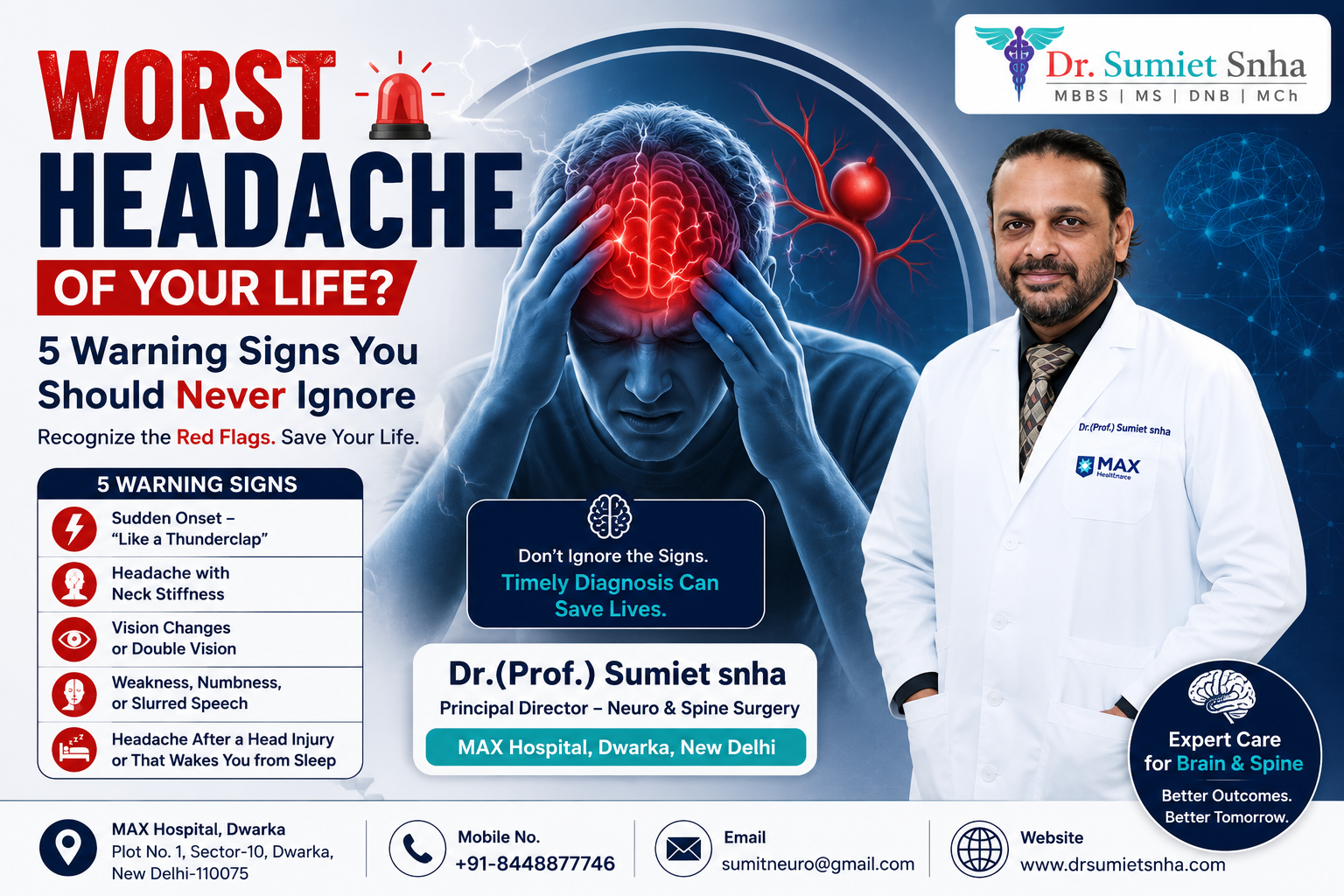
Worst Headache of Your Life: 5 Warning Signs You Should Never Ignore
Almost everyone gets a headache now and then — after a stressful day, poor sleep, or too much screen time. But every so often, a patient describes something different: "Doctor, this was the worst headache of your life.That specific phrase matters in medicine. It's not just a way of describing pain — it's a recognized red flag that doctors take seriously, not because every severe headache is dangerous, but because a small number signals something urgent. In this article, we'll cover what this phrase really means, five warning signs you shouldn't ignore, and when it's time to see a specialist.
What Does "Worst Headache of Your Life" Actually Mean?
Unusual Intensity or Sudden Onset
When doctors hear a patient describe their pain this way, we listen closely — because it usually points to one of two things: either a headache that is unusually intense compared to anything the person has experienced before, or one that came on with unusual speed.
What Makes a Thunderclap Headache Different
There's an important difference between a bad migraine and what we call a thunderclap headache. A migraine, even a severe one, typically builds up over minutes to hours, often with warning signs like visual flickering or nausea beforehand. A thunderclap headache is different — it reaches its peak intensity within seconds to a couple of minutes, hitting "like a clap of thunder" with no real warning. This sudden, explosive quality is what makes it medically significant, since it can sometimes point to bleeding around the brain.
5 Warning Signs You Should Never Ignore
1. Sudden Onset — "Like a Thunderclap"
If your headache goes from zero to unbearable in under a minute, that pattern itself is a warning sign, regardless of how the pain feels afterward. Most everyday headaches build gradually; a thunderclap headache does not.
2. Headache with Neck Stiffness
A headache paired with a stiff, hard-to-move neck can indicate irritation around the brain's protective lining, sometimes caused by bleeding in that space (subarachnoid hemorrhage). This combination is one doctors are trained to watch for closely.
3. Vision Changes or Double Vision
Blurred vision, double vision, or sudden difficulty focusing alongside a severe headache suggests the problem may involve pressure or blood flow changes affecting the brain, not just muscular tension.
4. Weakness, Numbness, or Slurred Speech Along with Headache
When a headache is accompanied by weakness on one side of the body, numbness, or slurred speech, it needs urgent evaluation — these combined symptoms can point toward a stroke or a bleed. (We've covered this combination in more depth in our related article on one-sided weakness and slurred speech.)
5. Headache After a Head Injury or That Wakes You from Sleep
A severe headache that develops after a fall or blow to the head, or one intense enough to wake you up from deep sleep, doesn't fit the pattern of an ordinary headache and deserves prompt medical assessment.
About Dr.(Prof.) Sumiet Snha
Background and Experience
This article is written and medically reviewed by Dr.(Prof.) Sumiet Snha, Vice Chairman – Neurosciences (Neurology & Spine), currently practicing at MAX Hospital, Gurgaon, India. With over 25 years of experience in the field of neurosurgery, Dr. Snha has treated a wide range of headache-related emergencies, including cases involving brain aneurysms and hemorrhages, as part of his broader practice in brain and spine care.
Key Credentials and Achievements
- Principal Director – Neuro & Spine Surgery, MAX Hospital, Dwarka, New Delhi-110075
- Ex-Director – Neuro & Spine Surgery, Paras Health, Gurugram, Haryana
- Ex-Professor, Department of Neurosurgery, All India Institute of Medical Sciences (AIIMS), New Delhi
- Secretary, Neurotrauma Society of India
- Founder Faculty In-charge, Cadaver Training and Research Facility, AIIMS, JPNA Trauma Centre — conceptualized and established a state-of-art cadaver training and research facility at AIIMS
- Founder Secretary, Indian Society of Peripheral Nerve Surgery
- Member of the Core Committee for the formulation of National Guidelines for Traumatic Brain Injury
- Expertise in minimally invasive spine surgeries, with lesser pain, trauma, and faster recovery for patients
- Performed 250+ complicated nerve injury surgeries with a higher success rate
Read More or Book a Consultation
You can read more about his background and expertise here or book a consultation if you have concerns about a severe headache.
Possible Causes Behind a Sudden, Severe Headache
Common, Manageable Causes
To be clear — most severe headaches turn out to have manageable causes, including very intense migraines, high blood pressure spikes, or tension-type headaches. However, a sudden, severe headache can occasionally be linked to more serious causes such as a brain aneurysm, bleeding around the brain, meningitis, or other vascular issues.
What the Research Shows
This isn't meant to alarm you. Research published in a large observational study found that subarachnoid hemorrhage accounted for roughly 32% of serious diagnoses among patients presenting with thunderclap headache, while the large majority of thunderclap headache cases — around 88% — ultimately turned out to be benign (source: NIH/PMC clinical study). According to the Cleveland Clinic, people who experience this type of bleed often describe it exactly as "the worst headache of their life," which is why this description is used as a clinical screening cue rather than dismissed as exaggeration. This context is meant to explain why doctors take the phrase seriously as a screening question, even when the eventual diagnosis is reassuring.
Migraine vs. Thunderclap Headache: Quick Comparison
|
Feature |
Typical Migraine |
Thunderclap Headache |
|
Onset speed |
Gradual (minutes to hours) |
Sudden (seconds to 1–2 minutes) |
|
Warning signs before pain |
Often yes (aura, visual flicker, nausea) |
Usually none |
|
Pain intensity |
Severe, throbbing |
Described as the worst pain ever felt |
|
Associated symptoms |
Light/sound sensitivity, nausea |
Neck stiffness, vision change, weakness (possible) |
|
Duration |
Hours, sometimes 1–3 days |
Peaks fast, may persist or ease |
|
Usual cause |
Migraine disorder |
Requires urgent evaluation to rule out bleeding/vascular cause |
|
Action needed |
Manage with rest, medication, follow-up if frequent |
Seek emergency evaluation immediately |
When Should You See a Neurosurgeon Immediately?
Consider it urgent if your headache comes with any of the following:
- Sudden, explosive onset unlike anything you've felt before
- Neck stiffness or sensitivity to light
- Vision changes, confusion, or difficulty speaking
- Weakness or numbness on one side of the body
- Onset after a head injury
- A headache severe enough to wake you from sleep
- Fever along with the headache
If any of these apply to you or someone you know, don't wait to see if it improves on its own — get evaluated the same day.
How Is the Cause of a Severe Headache Diagnosed?
Diagnosis is usually quick and straightforward. A neurosurgeon will typically start with a detailed history and neurological examination, followed by imaging such as a CT scan (often the first step in emergency settings) and, if needed, an MRI for more detailed views of the brain and blood vessels. In some cases, additional tests may be recommended based on the initial findings. Most patients are relieved to learn the process is fast and non-invasive.
Frequently Asked Questions
1. Is it normal to have the worst headache of my life just once? It can happen due to a severe migraine or stress-related headache, but any first-time "worst ever" headache should still be evaluated to rule out serious causes.
2. Can stress cause a sudden, severe headache? Yes, stress and tension can trigger intense headaches, but if the onset is sudden (thunderclap-like) or accompanied by other red-flag symptoms, stress shouldn't be assumed as the cause without medical evaluation.
3. What exactly is a thunderclap headache? It's a headache that reaches maximum intensity within seconds to about two minutes, unlike the gradual buildup seen in typical headaches.
4. When is a headache considered a medical emergency? When it's sudden and severe, or accompanied by neck stiffness, vision changes, weakness, confusion, or fever.
5. Can a brain aneurysm cause a sudden headache without any other symptoms? Yes, in some cases a headache may be the only symptom initially, which is why sudden severe headaches are taken seriously even without additional signs.
6. Is it possible to have a dangerous headache without any pain elsewhere in the body? Yes — the headache itself, especially if sudden and severe, can be the main indicator; associated symptoms may or may not be present.
7. How long does a thunderclap headache typically last? It can last from a few hours to a few days, though the "peak" intensity is reached almost immediately, unlike a slow-building migraine.
8. Can high blood pressure cause a sudden severe headache? Yes, a sharp spike in blood pressure can trigger an intense headache, which is another reason blood pressure is checked during evaluation.
9. Should I go to the ER or book a regular appointment for a sudden severe headache? If it's a first-time, sudden, "worst ever" headache — especially with any warning signs — an emergency evaluation is safer than waiting for a scheduled appointment.
10. Are thunderclap headaches more common in any particular age group? They can occur at any age, though certain underlying causes are more commonly seen in specific age groups, which your doctor can assess individually.
11. What tests will the doctor run for a sudden severe headache? Typically a neurological exam followed by a CT scan, and an MRI if further clarity is needed.
12. Can a severe headache with vision problems resolve on its own without treatment? It might, if the underlying cause is minor, but this combination should always be evaluated first rather than assumed to be harmless.
Conclusion
Not every bad headache is dangerous — most aren't. But the phrase "worst headache of my life" exists in medicine for a reason: it flags a small but important group of cases that need prompt attention. If your headache comes on suddenly, feels unlike anything you've experienced before, or is paired with neck stiffness, vision changes, weakness, or confusion, don't wait it out. Getting checked promptly is the safest path, and in most cases, it brings quick reassurance rather than bad news.
.jpg)
.jpg)
.jpg)



Write a Comment